

What I Learned, What Science Explains, and How I Came to Understand It Better
Hair loss is one of those topics that most people don’t plan to research until they have to. For me, it started subtly. A little more hair on the pillow, a slightly wider part in the mirror, a haircut that didn’t sit the same way it used to. At first, I brushed it off. Stress, maybe. Age, probably. Nothing serious.
But curiosity eventually took over, and I started reading. What I found was that hair loss is far more common, complex, and emotionally layered than I had ever realized. This article is not medical advice. It’s a carefully researched, first-person overview of what hair loss is, why it happens, how it’s discussed in U.S. medical literature, and what helped me make sense of it all.
Understanding Hair Loss Beyond the Surface
Hair loss, often referred to as alopecia, is something that affects millions of people in the United States. According to the American Academy of Dermatology, hair loss can occur in men and women and can begin at almost any age. (aad.org)
What stood out to me early on was how misleading the word hair loss can be. It doesn’t always mean baldness. Sometimes it’s thinning, sometimes slower regrowth, sometimes shedding that comes and goes. Understanding that distinction made the topic feel less alarming and more manageable.
The Hair Growth Cycle: Something I Had Never Thought About
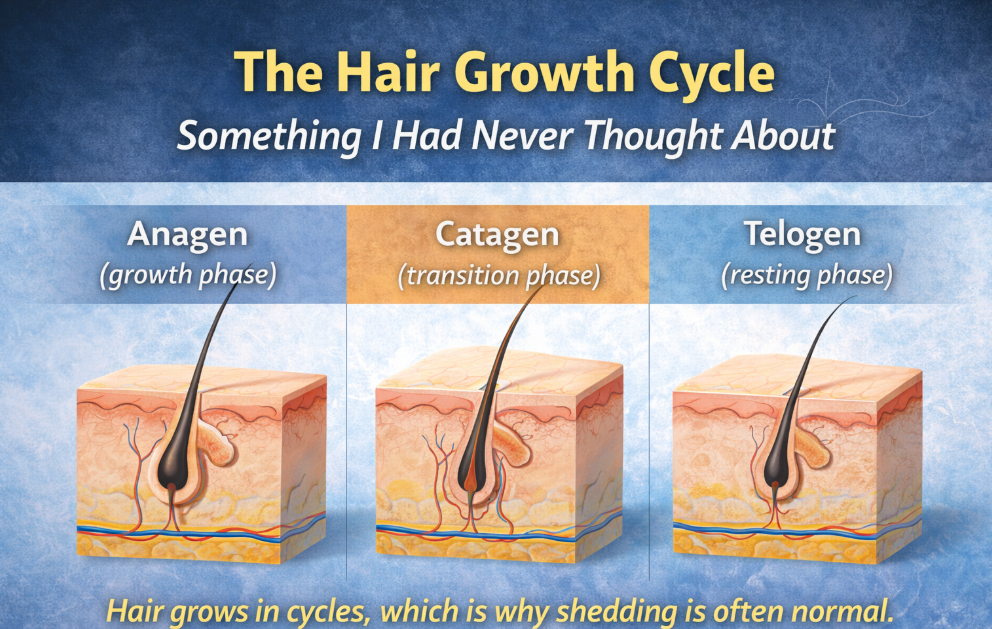
One of the most helpful things I learned was that hair doesn’t grow continuously. According to the National Institutes of Health, hair grows in cycles:
- Anagen (growth phase)
- Catagen (transition phase)
- Telogen (resting phase)
At any given time, different hairs are in different phases. This explains why shedding is normal and why some hair loss doesn’t indicate a problem at all. (nih.gov)
Realizing this helped me understand why panic over a few extra strands can be unnecessary.
The Most Common Cause: Androgenetic Alopecia
The condition that came up again and again in reputable sources is androgenetic alopecia, commonly known as male or female pattern hair loss. It is the most frequent cause of hair loss in the U.S. (American Academy of Dermatology)
This type of hair loss is influenced by genetics and hormones. In men, it often appears as a receding hairline or thinning crown. In women, it typically shows as overall thinning rather than complete baldness.
What struck me was how predictable and well-studied this pattern is, yet how personal it feels when it happens to you.
Hormones and Hair: Why DHT Keeps Coming Up
As I read more, one hormone kept appearing: dihydrotestosterone (DHT). DHT is a derivative of testosterone and plays a role in several normal biological processes. According to the NIH, DHT affects hair follicles in individuals who are genetically sensitive to it. (nih.gov)
In simple terms, in some people, DHT gradually causes hair follicles to shrink. Over time, this leads to thinner hair and eventually reduced hair growth. Importantly, this process does not happen to everyone, which explains why hair loss patterns vary so much even within families.
Hair Loss Isn’t Always Genetic
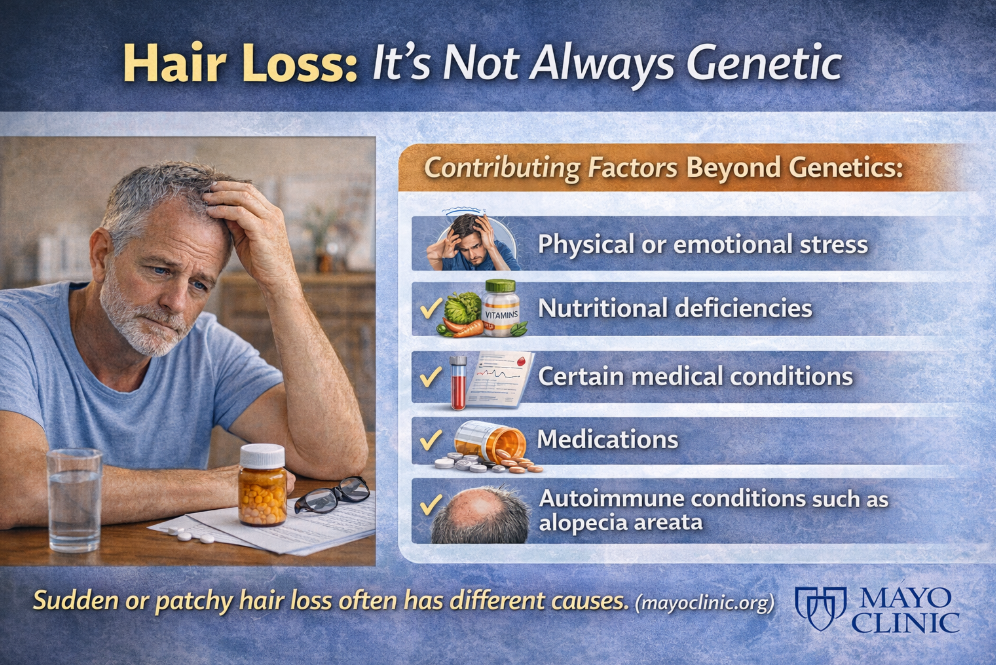
One of the biggest misconceptions I had was that hair loss is always hereditary. While genetics plays a major role, U.S. health institutions list several other contributing factors, including:
- Physical or emotional stress
- Nutritional deficiencies
- Certain medical conditions
- Medications
- Autoimmune conditions such as alopecia areata
The Mayo Clinic emphasizes that sudden or patchy hair loss often has different causes than gradual thinning. (mayoclinic.org)
Stress and Hair Loss: A Connection That Surprised Me
Stress-related hair loss, sometimes referred to as telogen effluvium, was something I hadn’t heard of before. According to the Cleveland Clinic, significant stress can push more hairs than usual into the resting phase, leading to noticeable shedding weeks or months later. (clevelandclinic.org)
What helped me here was learning that this type of hair loss is often temporary. That perspective alone made the experience feel less overwhelming.
Nutrition and Hair Health: What the Evidence Actually Says
I also came across countless claims online about miracle foods and supplements. However, U.S. medical organizations tend to be far more cautious. The Harvard T.H. Chan School of Public Health notes that hair growth relies on adequate nutrition, but excessive supplementation without deficiency may not be helpful. (hsph.harvard.edu)
Key nutrients often mentioned in scientific literature include protein, iron, and certain vitamins, but experts consistently recommend addressing deficiencies under medical guidance rather than self-treatment.
Hair Loss in Women: Often Overlooked
One thing I appreciated in U.S. dermatology resources is the emphasis on female hair loss, which is often under-discussed. According to the American Academy of Dermatology, women experience hair loss differently and may face unique emotional challenges. (aad.org)
Understanding this broadened my perspective and reinforced that hair loss is not a men only issue.
Psychological Impact: The Side That Doesn’t Show in Photos
What statistics don’t always capture is the emotional side of hair loss. The American Psychological Association has acknowledged that changes in appearance can affect self-esteem and confidence. (apa.org)
For many people, hair is tied to identity, youth, and self-expression. Recognizing this emotional weight helped me treat the subject with more compassion, both for myself and others.
When to Consider Professional Evaluation
One consistent recommendation across U.S. health sources is knowing when to seek medical advice. According to the Mayo Clinic, sudden hair loss, patchy bald spots, or hair loss accompanied by other symptoms may warrant evaluation. (mayoclinic.org)
This reinforced the idea that while hair loss is common, it shouldn’t always be ignored.
Separating Evidence From Online Myths
One challenge I faced was navigating misinformation. The internet is full of dramatic claims, but organizations like the CDC and NIH stress relying on evidence-based sources and professional guidance. (cdc.gov)
Learning how to evaluate sources became just as important as learning about hair loss itself.
Living With Hair Loss: A Shift in Perspective
Over time, my focus shifted from “How do I stop this?” to How do I understand this? That change made a surprising difference. Many people in the U.S. live full, confident lives with thinning hair or baldness. Some pursue treatments, some don’t, and both choices are valid.
Education helped me realize that hair loss doesn’t define health, success, or worth.
Why Education Matters More Than Quick Fixes
Hair loss isn’t a failure of discipline or self-care. It’s often a combination of biology, genetics, and life circumstances. Trusted U.S. health organizations consistently emphasize informed decision-making over panic-driven solutions.
That mindset alone can reduce anxiety and empower better conversations with healthcare professionals.
Final Thoughts
Hair loss is deeply personal, yet incredibly common. Learning about the science behind it helped me replace fear with understanding. Whether hair loss is genetic, stress-related, age-related, or temporary, approaching it with reliable information makes all the difference.
By relying on credible sources, realistic expectations, and open discussion, hair loss becomes less mysterious — and far less overwhelming.
This article is for informational purposes only and does not replace professional medical advice.
References
- American Academy of Dermatology – Hair loss causes and types
https://www.aad.org/public/diseases/hair-loss - Mayo Clinic – Hair loss overview
https://www.mayoclinic.org/diseases-conditions/hair-loss - National Institutes of Health (NIH) – Hair growth and alopecia
https://www.ncbi.nlm.nih.gov/books/NBK430924/ - Cleveland Clinic – Telogen effluvium
https://my.clevelandclinic.org/health/diseases/16948-telogen-effluvium - National Institute on Aging – Hair and aging
https://www.nia.nih.gov/health/hair-loss - American Psychological Association – Self-image and appearance
https://www.apa.org