

For a long time, I thought of body fat as something simple: too much was bad, less was better, and the goal was always to get rid of it. That belief came from years of fitness ads, social media before and after photos, and casual conversations that framed body fat as an enemy.
But the more I read, especially from reputable U.S. health organizations, the more I realized how incomplete that view was. Body fat isn’t just excess weight. It’s a complex, biologically important tissue that plays essential roles in the human body. Understanding that changed how I think about health, fitness, and even self image.
This article is not medical advice. It’s a carefully researched, first-person exploration of what body fat actually is, how it functions, why it varies between people, and how it’s discussed in U.S. medical and public health literature.
What Body Fat Really Is (Not What I Thought It Was)
Body fat, also known as adipose tissue, is a type of connective tissue found throughout the body. According to the National Institutes of Health, it stores energy, insulates the body, and helps regulate hormones. (nih.gov)
What surprised me most was learning that body fat is metabolically active. It isn’t just stored calories. Fat cells release hormones and signaling molecules that influence appetite, inflammation, and metabolism.
That alone made me realize that treating body fat as purely negative doesn’t align with how the body actually works.
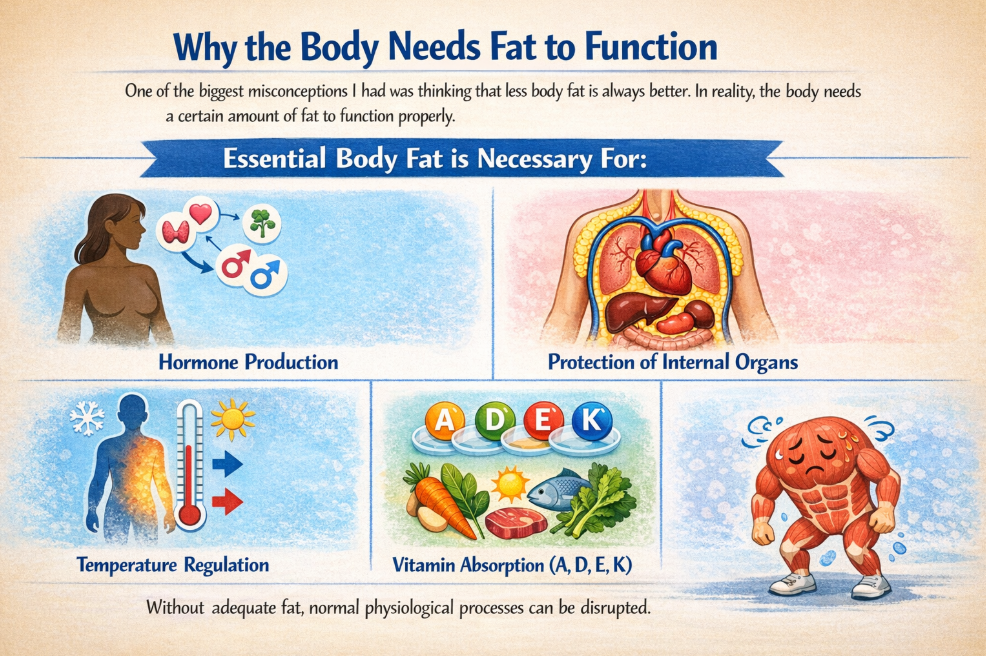
Why the Body Needs Fat to Function
One of the biggest misconceptions I had was thinking that less body fat is always better. In reality, the body needs a certain amount of fat to function properly. According to the Cleveland Clinic, essential body fat is necessary for:
- Hormone production
- Protection of internal organs
- Temperature regulation
- Absorption of fat-soluble vitamins (A, D, E, K)
Without adequate fat, normal physiological processes can be disrupted. (clevelandclinic.org)
This perspective helped me understand why extremely low body fat levels are often promoted in some fitness spaces, which are not sustainable or healthy for most people.
Different Types of Body Fat I Didn’t Know Existed
Before researching this topic, I assumed all body fat was the same. It turns out that’s far from true.
Subcutaneous Fat
This is the fat stored just under the skin the kind most people can pinch. According to Harvard Health, subcutaneous fat plays a role in insulation and energy storage. (health.harvard.edu)
Visceral Fat
Visceral fat surrounds internal organs in the abdomen. U.S. health organizations often pay special attention to this type because it’s associated with metabolic processes. (CDC)
Learning the difference helped me understand why waist circumference is sometimes discussed alongside weight and BMI.
Body Fat Distribution: Why It’s So Individual
One thing that became very clear is that where people store fat varies widely. Genetics, hormones, age, and sex all influence fat distribution. The National Institute of Diabetes and Digestive and Kidney Diseases explains that men and women often store fat differently due to hormonal differences. (niddk.nih.gov)
This helped explain why two people with similar body weights can look very different and why comparison is rarely helpful.
Body Fat Percentage vs Body Weight
For years, I equated health with the number on the scale. What I didn’t realize is that weight alone doesn’t distinguish between fat, muscle, bone, and water.
Body fat percentage, while not perfect, provides more context. According to the American Council on Exercise, body fat ranges vary by sex and age. (acefitness.org)
Understanding this shifted my focus away from weight loss as the sole indicator of health.
BMI and Body Fat: What It Can and Can’t Tell Us
Body Mass Index (BMI) is commonly used in the U.S. as a screening tool, but even major health organizations acknowledge its limitations. The CDC states that BMI does not directly measure body fat and may not reflect individual health accurately. (cdc.gov)
Learning this helped me stop treating BMI as a personal verdict and instead see it as one data point among many.
How Body Fat Changes With Age
Another thing I hadn’t fully appreciated is how body composition naturally changes over time. The National Institute on Aging explains that muscle mass tends to decrease with age, while fat mass may increase even if body weight stays the same. (nia.nih.gov)
This made me rethink expectations around aging and body shape and how unrealistic some standards can be.
The Emotional Side of Body Fat
While researching scientific facts, I kept coming back to how emotional this topic is. Body fat is often tied to self-esteem, social perception, and mental health.
The American Psychological Association notes that body image concerns are common and can affect people of all ages and genders. (apa.org)
Understanding that emotional responses to body fat are normal and often socially conditioned helped me approach the subject with more empathy.
Diet, Body Fat, and Oversimplification
One of the most confusing parts of learning about body fat is sorting through diet advice. U.S. health authorities consistently caution against oversimplified messages.
According to the National Institutes of Health, body fat levels are influenced by energy balance, genetics, environment, and behavior not a single food or nutrient. (nih.gov)
This reinforced the idea that long-term habits matter more than short-term restrictions.
Physical Activity and Body Composition
Exercise is often discussed in relation to fat loss, but what stood out to me is how physical activity affects overall body composition.
The CDC recommends regular physical activity for overall health, not just weight control. Exercise supports muscle mass, metabolic health, and cardiovascular fitness regardless of visible fat changes. (cdc.gov)
This helped me detach physical activity from purely aesthetic goals.
Why “Spot Reduction” Is a Myth
I spent years believing that targeting certain exercises would reduce fat in specific areas. According to Harvard Medical School, research does not support spot fat reduction. Fat loss tends to occur throughout the body rather than in isolated areas. (health.harvard.edu)
Learning this saved me a lot of frustration and unrealistic expectations.
Medical Perspectives on Body Fat
Healthcare professionals in the U.S. often look at body fat as part of a broader health picture. The Cleveland Clinic emphasizes that health assessments include multiple factors such as blood pressure, cholesterol, glucose levels, and lifestyle. (clevelandclinic.org)
This reminded me that body fat alone does not define health.
Body Fat, Media, and Cultural Pressure
One thing that became impossible to ignore is how the media shapes perceptions of body fat. Unrealistic standards are common, especially in advertising and entertainment.
Public health experts frequently encourage media literacy and self-compassion as part of a healthy relationship with body image. (nia.nih.gov)
Understanding this helped me separate health goals from appearance-based pressure.
When Body Fat Becomes a Health Conversation
While body fat is not inherently negative, U.S. health organizations do discuss situations where excess fat may be associated with health risks. Importantly, these discussions emphasize individualized care rather than one-size-fits-all judgments. (CDC)
This nuance made the topic feel less stigmatizing and more practical.
Why Education Changed My Perspective
Learning about body fat didn’t give me a perfect body or a fixed answer. What it gave me was clarity. I stopped seeing fat as a moral failure and started seeing it as a biological reality influenced by many factors.
Education didn’t eliminate complexity it helped me live with it more comfortably.
Final Thoughts
Body fat is neither the villain nor the hero it’s often made out to be. It’s a normal, necessary part of human biology that varies widely from person to person. Understanding how it works, why it exists, and how it’s discussed in credible U.S. health research helped me replace judgment with knowledge.
When we approach body fat with curiosity instead of fear, we open the door to healthier conversations — with ourselves and with healthcare professionals.
This article is for informational purposes only and does not replace professional medical advice.
References (U.S.-Based & Authoritative)
- National Institutes of Health (NIH) – Adipose tissue
https://www.ncbi.nlm.nih.gov/books/NBK279438/ - Centers for Disease Control and Prevention (CDC) – Obesity and BMI
https://www.cdc.gov/obesity - Cleveland Clinic – Body fat basics
https://my.clevelandclinic.org/health/body/21861-body-fat - Harvard Health Publishing – Understanding fat
https://www.health.harvard.edu/staying-healthy/the-truth-about-fat - National Institute on Aging – Healthy weight
https://www.nia.nih.gov/health/maintaining-healthy-weight - American Psychological Association – Body image
https://www.apa.org